Following a calendar week of bombshell developments inwards the industry, from the SEC classifying the DAO Tokens equally securities to the arrest of Alexander Vinnik for allegedly laundering four billion dollars through BTC-E, the maiden Blockstack Summit kicked off on the morn of July 27th amongst an midpoint toward innovative layered protocols that tin plough over the axe be on overstep of existing blockchains.
Hosted at the Computer Science Museum inwards Mountain View, CA, the conference began amongst a intelligence of transitions betwixt the “terminal model” of computing together with the personal estimator over the course of educational activity of digital history. In their talk, Blockstack co-founders Muneeb Ali together with Ryan Shea discussed how recent moves toward cloud computing together with storage accept away the information privacy together with safety guarantees long afforded past times personal computing. In answer to this problem, Blockstack together with other decentralized applications built on overstep of diverse blockchains aim to plough over consumers the might to control, larn by together with streamline their ain digital lives.
Elizabeth Stark, co-founder together with CEO of Lightning Network, together with then discussed recent technical developments that allow for both higher transaction volumes through specialized off-chain payment channels together with transactions betwixt ii unlike types of cryptocurrencies. These developments are saving both parties transaction fees inwards the long run together with helping alleviate some of the scaling issues that bitcoin together with other currencies cause got been facing inwards recent years.
Learn to a greater extent than almost Lightning Networks inwards our three-part series, Understanding the Lightning Network.
Bram Cohen, BitTorrent creator, took the phase afterward amongst Blockstack’s Ali to beak over developments inwards the space. When asked almost the scaling debate together with recent implementation of SegWit, Cohen drew chuckles from the crowd amongst an adamant proclamation that “SegWit solved a põrnikas that should cause got been solved when Bitcoin was created.”
Cohen also endorsed Bitcoin Core together with shared his doubts regarding the technical competency of the teams behind some of the to a greater extent than recent ICOs of ERC20 tokens built on overstep of the Ethereum blockchain: "As a full general rule, if you lot don't cause got the skills to attain your ain token from scratch, you lot shouldn't run an ICO.”
Nick Szabo, estimator scientist together with legal scholar, together with then discussed the origins of contract law, the historical implementation of smart contracts together with the side past times side steps the manufacture needs to accept to implement smart contracts inwards a diversity of commercial transactions, both betwixt consumers together with companies together with betwixt companies themselves.
Drawing on his studies at George Washington University Law School, Szabo advocated for the integration of smart contracts into traditional contract together with holding constabulary frameworks. Instead of attempting to rebuild legal theory from scratch, developers should travel amongst existing frameworks that cause got already been debugged for centuries.
Szabo explained a dichotomy of contract law: “dry code,” where an entire understanding tin plough over the axe hold upwards interpreted together with executed past times computers based on a number of digital inputs; together with “wet code,” or traditional law, where the agreements are interpreted past times private parties based on their ain definitions of words together with phrasing.
Many industries be today to assistance quantify together with define examples of “wet code” inwards the world. Insurance claim adjusters analyze accident reports together with eyewitness testimony inwards monastic enjoin to correctly pay out claims based on error together with the monetary value of the actual damages suffered past times each party, for example.
Translating poorly organized information from real-world situations into a serial of executable actions based on the damage of an understanding is a valuable service. Rather than telephone telephone for an abolishment of these systems, Szabo argued that the time to come of decentralized smart contracts volition be inwards tandem amongst the best parts of to a greater extent than traditional finance industries inwards the coming future. Over the coming years, larger portions of traditional information analysis volition larn obsolete, performed digitally past times to a greater extent than powerful together with intelligent computers.
This is non the get-go fourth dimension Szabo has spoken on the subject: As early on equally 2008, Szabo broke downwardly the differences betwixt moisture together with dry out code on his blog, Unenumerated.
Next, Balaji Srinivasan, founder of 21.co together with a16z Board Partner, introduced the Nakamoto coefficient, a metric inspired past times the Lorenz curve together with Gini coefficient to quantify the relative decentralization of unlike types of cryptocurrencies. By looking at the distribution of might inwards half dozen subsects of private cryptocurrencies, Srinivasan was able to compare the relative strengths of unlike blockchains together with networks against attacks that require a bulk or supermajority of the might inwards a arrangement to hold upwards compromised.
Srinivasan started past times organizing the half dozen essential subsystems of both Bitcoin together with Ethereum:
-
mining, where might is equal to who receives mining rewards;
-
clients, where might is equal to the number of users;
-
developers, where might is relatively equal to the number of commits;
-
exchanges, where might is equal to trading volume;
-
nodes, where might is measured past times the distribution of nodes or hence the world; and
-
coin ownership, where might is measured past times how much money each wallet address contains.
After calculating the amount of might owned past times each entity inwards the half dozen subsystems, Srinivasan was able to calculate a Gini coefficient (dubbed the “Nakamoto coefficient”) based on the relative might concentrations for each subsystem. For instance, if every miner has the same amount of hashpower together with receives the same reward, the subsystem would have a value of 0. If a unmarried miner receives all of the rewards, together with then the subsystem would have a value of 1.
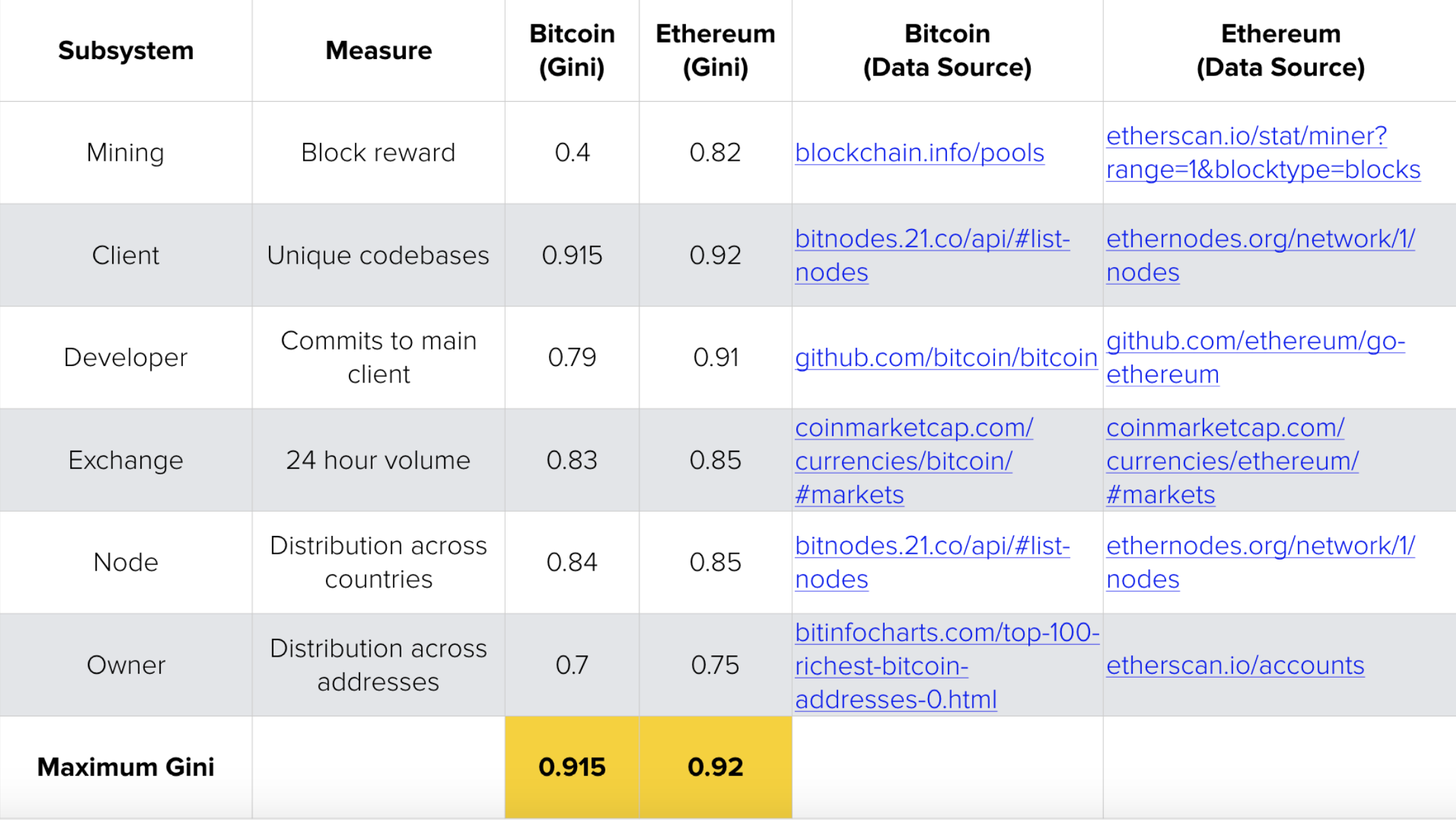 Srinivasan’s Nakamoto coefficient calculations for Bitcoin together with Ethereum
Despite a myriad of differences, both Bitcoin together with Ethereum cause got nearly identical Nakamoto coefficients of ≈0.91, indicating that at to the lowest degree i subsystem inwards each ecosystem is highly centralized. However, based on Srinivasan’s calculations, it’s clear that Bitcoin is either slightly (client, exchanges, nodes together with owners) or drastically (mining together with developers) to a greater extent than decentralized than Ethereum. Most surprisingly, Bitcoin’s mining network is far to a greater extent than decentralized than Ethereum’s (0.4 vs. 0.82).
This is the get-go fourth dimension Srinivasan has discussed a metric for decentralization of cryptocurrency markets. He has since published his findings, amongst links to the underlying datasets, on his company’s blog.
After a panel discussing specific role cases for cryptocurrency payments, Wealth together with Poverty writer George Gilder led a rousing endorsement of a tokenized, decentralized spider web together with its might to destroy “silos” of the meshwork created both past times countries together with companies alike.
Citing the vast amounts of information companies similar Facebook, Google together with Amazon relieve together with stair out almost their users’ digital lives, Gilder spoke of a time to come where individuals tin plough over the axe explicitly command the flow of their data, secured past times decentralized protocols together with powered past times tokens.
It was plumbing equipment that Blockstack Summit was held inwards the Computer History Museum, an ode to the stories together with artifacts of the information historic catamenia together with its touching on on society. With fully restored IBM mainframes, an Apple I together with the source codes of dozens of impactful softwares similar MS-DOS, Photoshop together with Word, the museum served equally a backdrop for discussions that expect to an open, costless together with uncensored gild of the future.
Read Article Full Blockstack Summit Tackles the Future of Decentralization : http://ift.tt/2vmuR1I
